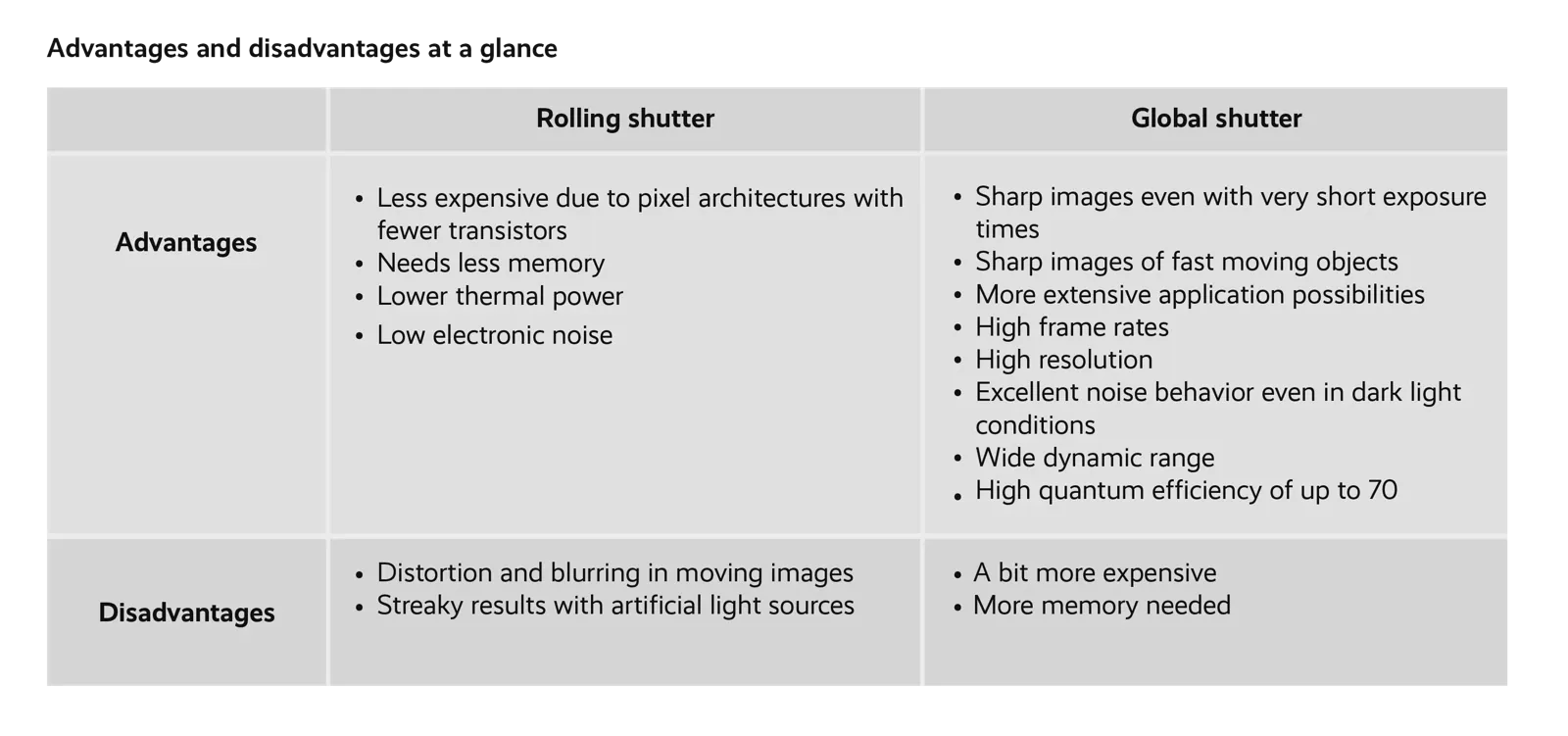
Whether license plate recognition, automated quality control (Quality 4.0), monitoring production processes or inspecting barcodes: Selecting the right camera sensor for industrial image processing poses challenges for machine vision users. In addition to considering various parameters such as sensor type, interfaces, resolution, frame rate, exposure time, sensor size and quantum efficiency , the exposure method (shutter) also plays an important role.
1. Sensor types and shutter
In its original function, the shutter shields the camera film from light and opens when the shutter release button is pressed. Depending on the exposure time set, the image then appears brighter (longer exposure time) or darker (shorter exposure time). The same principle can be found in the CMOS or CCD sensors that are commonly used today instead of film. These read out images electronically by converting light (photons) into electrical signals (electrons). Each image is composed of a large number of horizontal lines, which in turn consist of a different number of pixels depending on the resolution. CCD sensors are suitable for applications that do not require high frame rates (max. 30 fps) or high resolutions (max. 2 MP) and achieve very good image quality even in low light conditions. Due to their special properties such as longer exposure time in dark skies, high measurement accuracy or high data depth, CCD sensors are still of particular interest in the scientific sector (e.g. astronomy, microscopy).
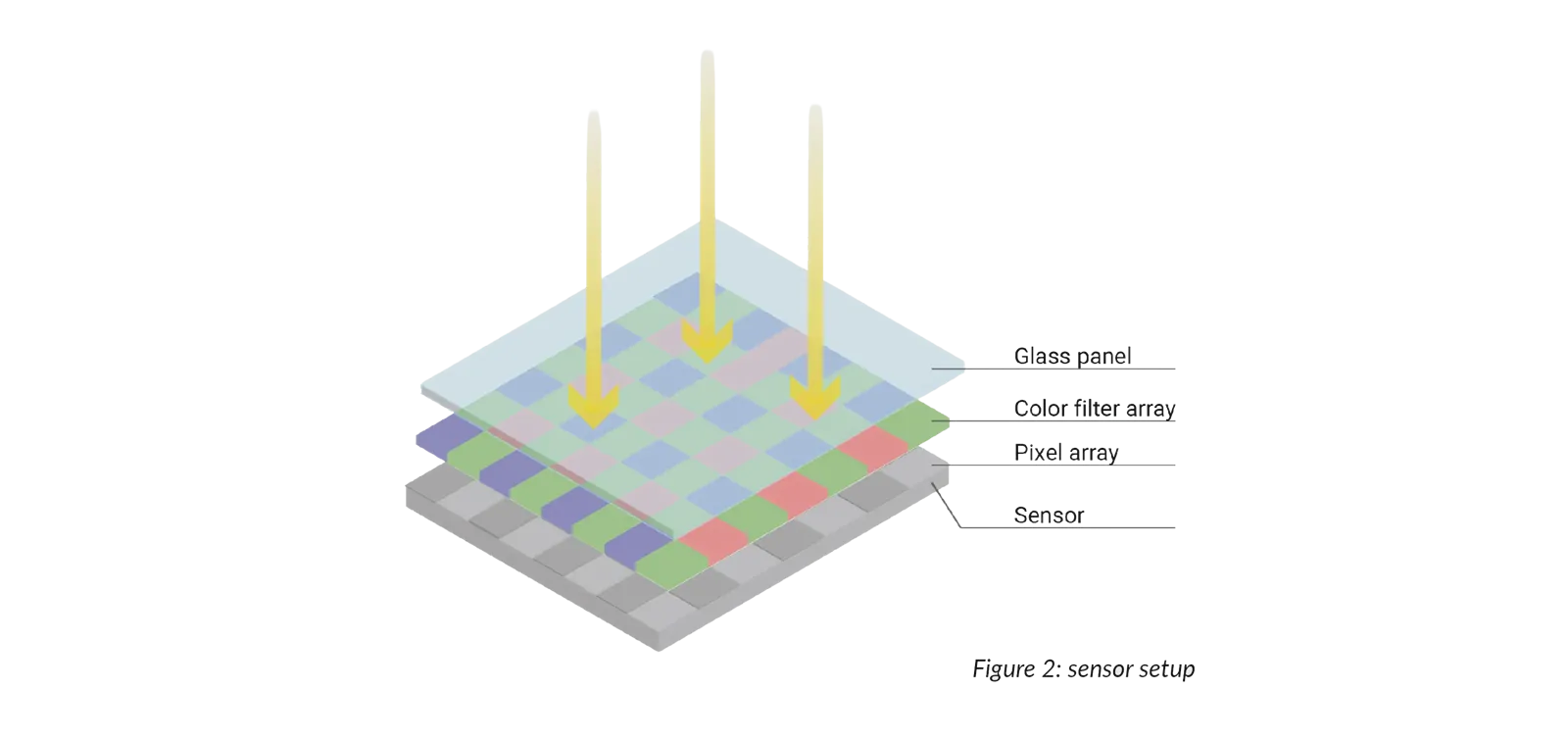
Sensors with CMOS technology, on the other hand, are considered for applications that require high resolution and high frame rates and are therefore particularly suitable for industrial image processing as well as in the ITS area. Because of their low cost and fast readout speed, CMOS sensors have become widely accepted over CCD sensors. In addition, they convince with lower energy consumption, lower heat production, improved quantum efficiency, improved noise properties and a good price-performance ratio. The older CCD sensors are equipped with global shutter due to their design. With the more modern CMOS sensors, a distinction is made between rolling shutter and global shutter sensors according to the type of exposure.
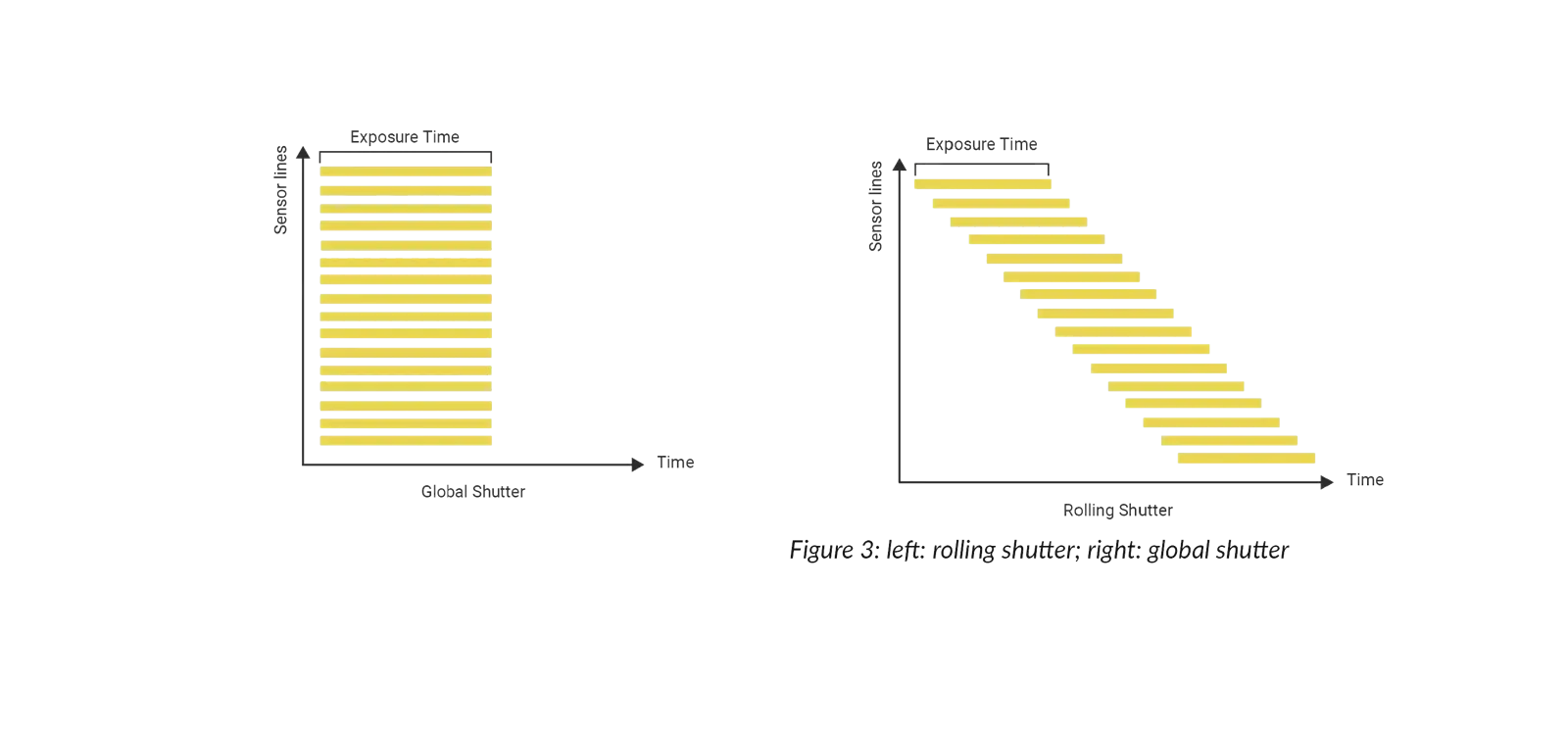
A rolling shutter sensor does not expose an image as a whole, but with a time delay according to rows or columns. This means that the image is not read out for all image pixels simultaneously, but sequential. With a global shutter sensor, on the other hand, all pixels, i.e. the entire image, are exposed at the same time.
2. Problem: Rolling shutter effect
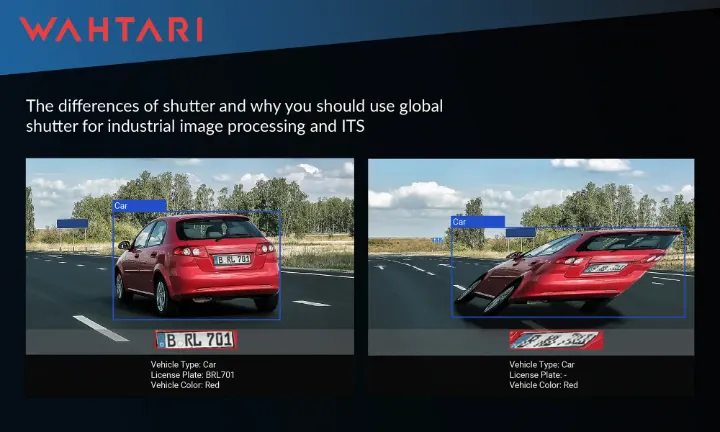
The differences between global shutter and rolling shutter sensors are most apparent in dynamic image capture: While a global shutter sensor correctly displays moving images, since the moving subject is photographed as a whole (snapshot of the entire image), rolling shutter sensors can cause geometric distortions and deformations (so-called rolling shutter effect). This occurs because the moving object is already at a different position on the image sensor for each line during sequential readout. When all lines are combined into one image, the moving subject then appears crooked or distorted. In addition, when taking pictures under brightness fluctuations (e.g., due to the flickering of artificial light sources that is invisible to the human eye), dark and light stripes may appear on the image.
It is true that the rolling shutter effect can be partially mitigated by fast image readout rates, elaborate flashand ambient light shading constructions, or subsequent processing with appropriate programs.

However, the additional cost levels outweighs the basic price advantage of rolling versus global shutter sensors, and flash constructions only produce usable results in dark environments, but not in continuous lighting. So for tasks that require high image accuracy it makes sense to use global shutter sensors from the outset to avoid poor results or subsequent cost, hassle and time.
3. Solution in the industry: Global shutter
For this reason, it is imperative that CMOS sensors in the industrial image processing sector are equipped with a global shutter. From our point of view, meaningful quality and production controls using machine vision solutions are only conceivable under this premise. Especially under industrial conditions (no daylight, automated and fast motion sequences, vibrating and moving machines, dust, etc.) and also in license plate recognition in the higher speed range, rolling shutter cameras are very prone to errors and lead to distorted or inaccurate images. The rolling shutter effect is therefore particularly noticeable here, making image evaluation more difficult or even impossible.
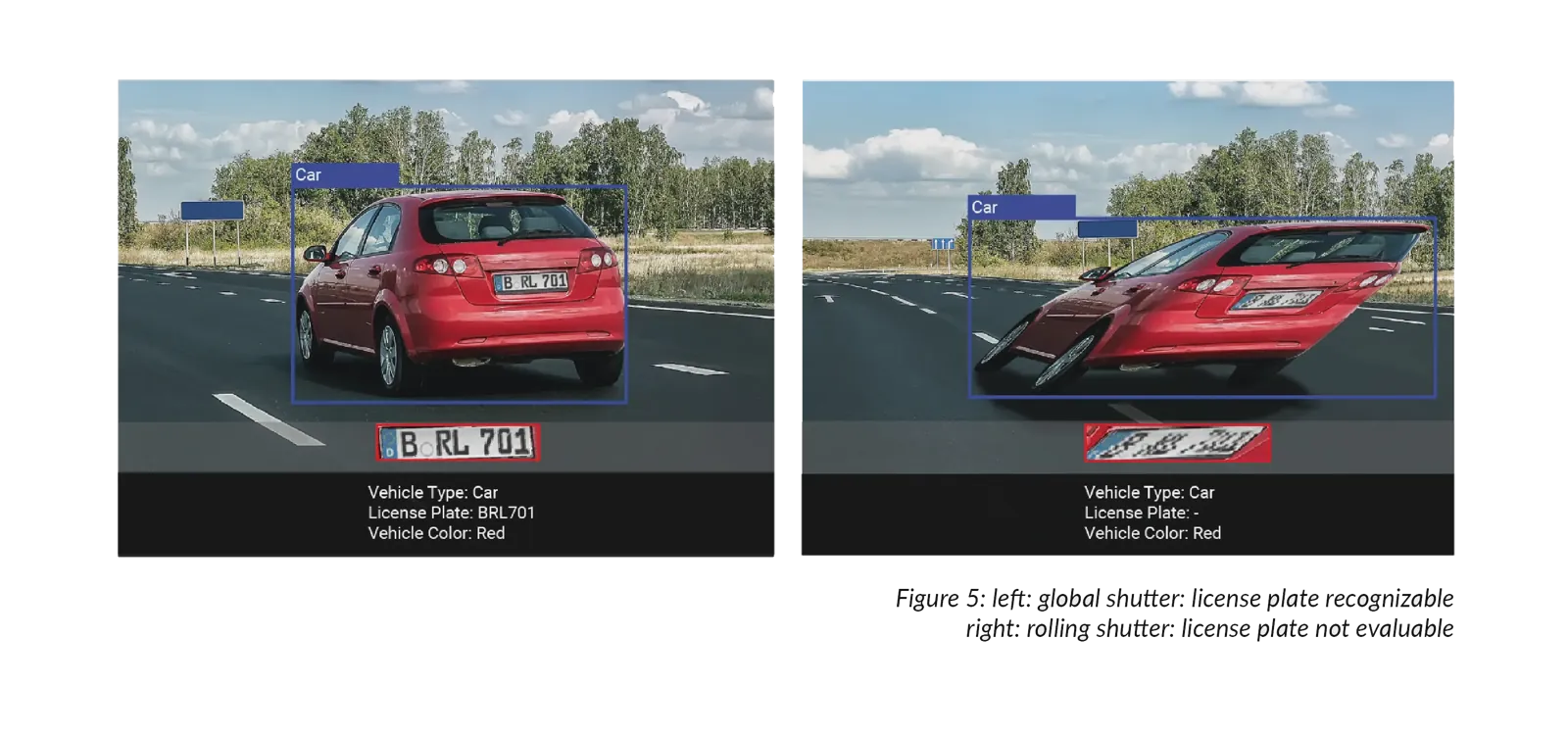
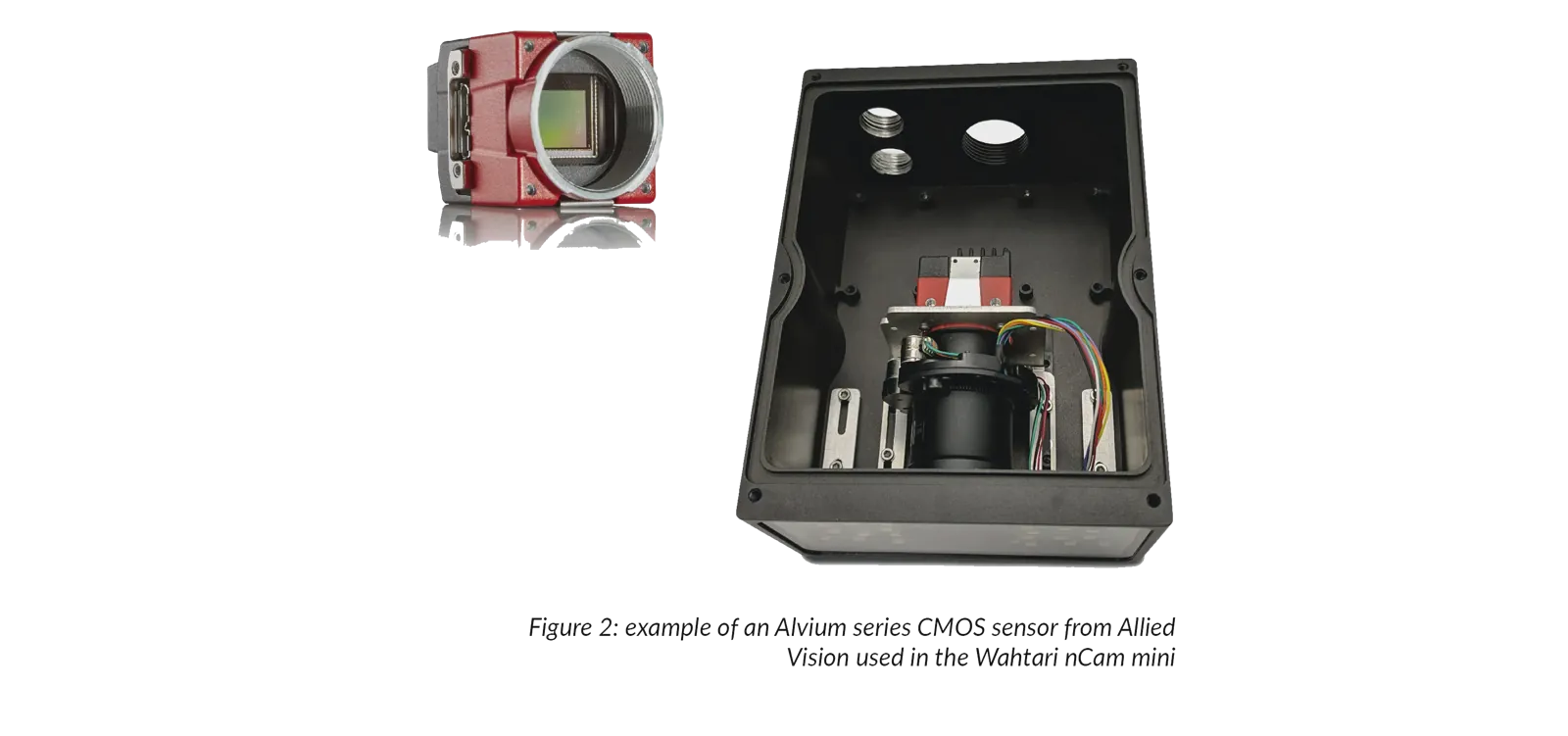
In contrast to many other manufacturers, Wahtari offers the option of equipping all nCam variants with global shutter sensors. This allows our nCam to produce razor-sharp images even in high-frequency processes (e.g. assembly line production) or high speeds (e.g. traffic monitoring), which can be easily evaluated by the integrated AI. Wahtari relies on the image sensors of the Alvium series from Allied Vision. This includes numerous models with high-performance image sensors from 0.5 to 20.4 megapixel resolution and forms a solid foundation for the highest image quality.
With global shutter sensors from Allied Vision, Wahtari relies on strong quality directly at the lowest level of image recognition to optimize recognition accuracy in image evaluation while maintaining production speed.