
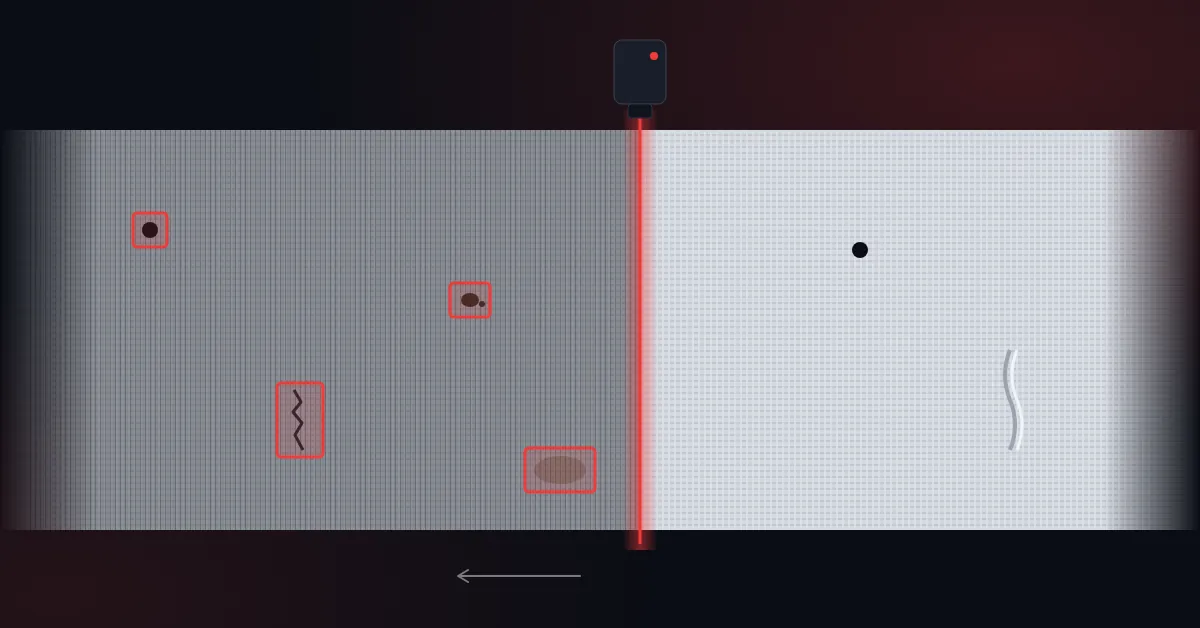
A web has no beginning and no end where you could take a photo. Paper, films, nonwovens, textiles and sheet metal run non-stop through extruders, coating, laminating or weaving machines. When the process has a problem, the defect often runs on for many meters – and otherwise only shows up during converting. A random sample sees only a small part of the web. Our web inspection with nScan sees every meter.
Line by line, across the full width
For web inspection, we use line-scan cameras. They capture one image line across the web; as the web runs beneath them, these lines form a continuous image with no gaps between the shots. Several cameras side by side cover wide webs – scalable to several meters of web width, on both sides of the web if required.
The analysis runs directly at the machine, without a cloud. The system processes raw data in the Gbit/s range in real time, thanks to zero-copy from the camera into GPU memory. Defects are reported immediately while production is running.
Patterns, seams and structure are not defects
Fabrics, nonwovens and printed webs have a structure that repeats constantly or varies naturally. Fixed thresholds have to either let defects through or reject good material. Instead, our AI learns from examples what flawless material looks like – with its pattern, seams and natural variation – and reports only real deviations. New materials are taught with Teach & Go in seconds to minutes, without programming.
 Camera image
 AI heatmap
 Camera image
 AI heatmap
What nScan finds on the web
Anomaly detection also finds complex defect patterns that nobody had to describe as a rule beforehand. Typical defects are:
- holes, tears and cuts in film, paper, nonwovens or fabric
- inclusions and foreign particles in the material
- stains, contamination, adhesions and residues
- folds, creases, dents and other deformations
- scratches and surface damage
- color deviations and defects in the print and the pattern
Every defect is automatically assigned to a defect class and logged with its image. The type of defect shows where in the process the cause lies.
From paper to the finished garment
nScan is not tied to one material: paper, board, pulp and tissue, plastic, adhesive and foam films, nonwovens, fabrics with patterns or seams up to complete garments, leather, sheet metal and glass panes. Paper with watermarks is a special case: nScan automatically checks whether the watermark is complete, whether it has defects and how it is embossed. The AI watches the running production and learns by itself within seconds – with no training and no golden sample.
How small can a defect be?
You decide. Web width, speed and smallest defect size determine the choice of camera, optics, lighting and computing power. Thanks to our modular platform, we install cameras from any manufacturer and add laser profile sensors if needed. A proof of concept shows how far this can go: in it, we found and made visible tiny nickel sulfide inclusions in glass panes.
And when a defect is found?
You decide: a defect report per roll, marking of the defect on the web with a marking system of your choice, or a line stop. nScan connects via PROFIBUS, PROFINET, OPC UA or REST API and can be retrofitted into existing lines. Images and data stay in your plant.
Learn more
All details, more defect images and frequently asked questions are on our web inspection page. Want to know whether it works for your material? Get in touch.